
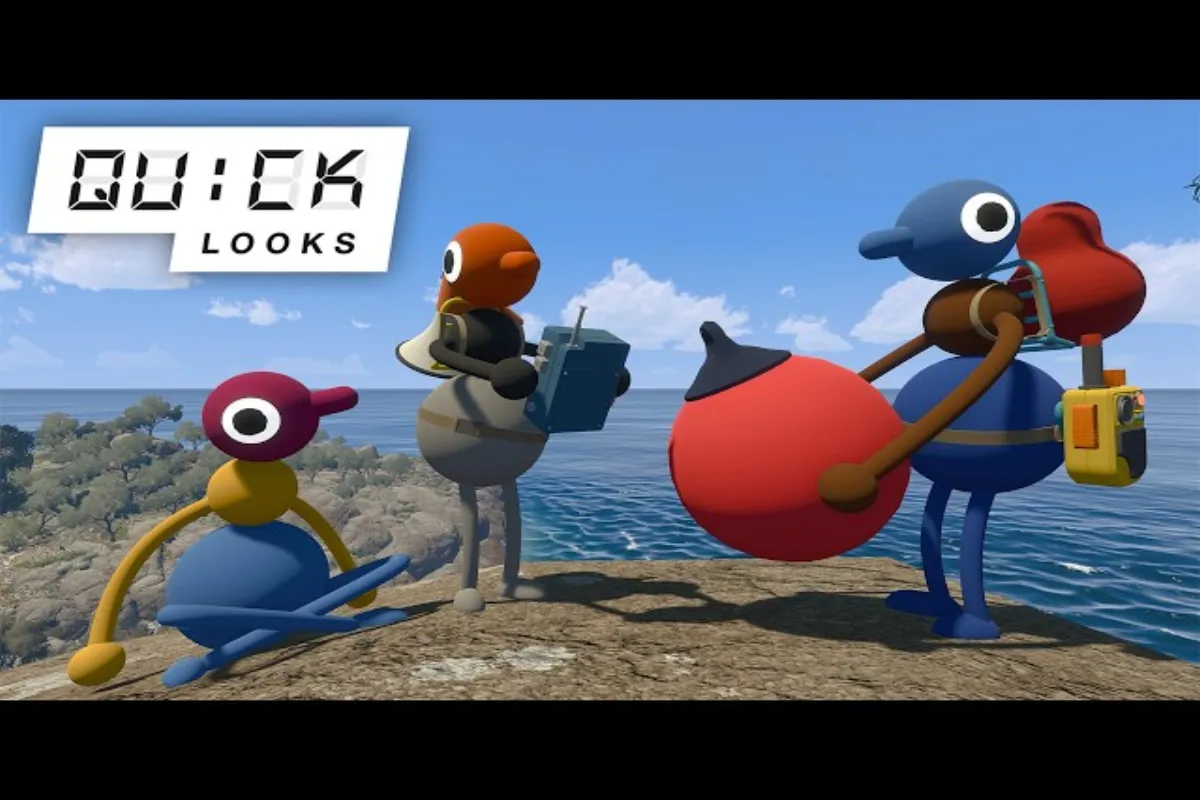
The Big Walk Creative Team and Untitled Goose Game Legacy
Big Walk arrives from House House, the same Melbourne-based indie studio that built the viral chaos of Untitled Goose Game. The team's signature blend of absurdist humor, environmental puzzle design, and minimal mechanical clutter carries forward into this cooperative outing, which trades a single mischievous goose for a small group of friends exploring open landscapes together. Knowing who is behind the project frames nearly every design decision players encounter, from the way objects react to subtle nudges to how dialogue is delivered in clipped, comedic snippets.
House House was founded in 2013 by four developers who met while studying at the University of Melbourne. After a handful of smaller releases, the studio broke through globally with Untitled Goose Game in 2019, a stealth-puzzle title that won both the BAFTA Game Award for Game of the Year and the D.I.C.E. Award for Outstanding Achievement in Game Design. That success gave the studio the freedom to experiment with broader concepts, and Big Walk reflects the result of several years of internal prototyping before its public reveal. The team's creative voice stayed intact even as scope expanded, which is why longtime fans still recognize the studio's fingerprints in nearly every system.
That influence shows up in small details. Players report that the texture palette, the reactive physics on tossed items, and the way ambient creatures scatter when startled all feel familiar to anyone who spent time herding villagers as the goose. The difference here is shared focus: rather than a single agent of chaos, Big Walk hands control to a small crew and asks what happens when curiosity becomes collaborative. House House has stated in interviews that the goal was to preserve the goose's sense of playful disruption while removing the loneliness of playing alone, and players can feel that intent in nearly every shared moment.
From Goose to Group: The Studio's Evolution
House House's portfolio between Untitled Goose Game and Big Walk is short but instructive. Their follow-up experiments leaned into physics-driven comedy and player-driven storytelling without dialogue-heavy exposition, a hallmark of their design ethos. Big Walk lands as the studio's most ambitious scope to date, and community discussions around the project's reveal suggest fans see it as a natural expansion of the studio's design instincts rather than a departure from them. The studio's approach has always prioritized clever restraint over feature bloat, and that philosophy carries directly into how Big Walk's mechanics, audio, and pacing were designed.
How House House's Design Philosophy Shapes Big Walk
House House has consistently built games around one core idea: place the player in a constrained space, give them a handful of verbs, and let the resulting chaos write the story. Big Walk continues that lineage while opening the sandbox to friends. The studio's design philosophy leans on environmental readability, meaning every object telegraphs its purpose without on-screen prompts, which lets players improvise solutions instead of memorizing scripted answers. That commitment to visual storytelling is a throughline that runs from the goose's briefcase-grabbing puzzles to Big Walk's cooperative exploration routes.
That philosophy translates into a few recurring patterns worth recognizing:
-
Loose objectives: rather than gating progress behind hard checkpoints, the game nudges players toward goals with subtle visual cues and audio pings.
-
Emergent comedy: most of the laugh-out-loud moments come from physics interactions, not scripted cutscenes, which keeps each session feeling fresh.
-
Minimal UI: the HUD stays out of the way so the world can carry the storytelling load, a House House signature.
-
Forgiving failure: buddies can revive each other, so the game never punishes experimentation as harshly as the goose did.
Players who bounced off Untitled Goose Game's puzzle pacing often find Big Walk more inviting because the cooperative framing lowers the friction of trial and error. Where the goose could fail silently and lose progress, a walking buddy can rescue you from a botched leap or suggest a detour on the fly. That soft reset loop is one of the clearest ways the studio adapted its design instincts to fit a co-op audience without losing the original tone.
The Untitled Goose Game DNA in Big Walk's Mechanics
| Mechanic Category | Untitled Goose Game Approach | Big Walk Cooperative Adaptation |
|---|---|---|
| Player Agency | Single NPC with limited verbs | Multi-character with shared item use |
| Pacing | Short, discrete objectives | Open-world wandering with optional goals |
| Comedy Source | Honk-based interactions | Group banter and physical slapstick |
| Failure State | Quick restart, low penalty | Buddy revive, soft respawn |
| Audio Cues | Honking as primary signal | Layered ambient + character vocalizations |
The table makes the family resemblance obvious without flattening the differences. Big Walk is not Untitled Goose Game with extra players glued on; it borrows the underlying design grammar and applies it to a much larger canvas. Several community testers have pointed out that the verb set feels familiar even when the contexts are wildly different, which is exactly the kind of cross-title continuity House House seems to want.
Big Walk Soundtrack Composer and Musical Direction
The Big Walk soundtrack is one of the most-discussed aspects of the game among early players, partly because House House's previous title used music so sparingly that fans wondered whether the studio would lean the opposite direction this time. According to community reports, the answer is yes: Big Walk features a more present musical layer than its predecessor, with composer Nathalie Lawhead reportedly contributing original work alongside returning collaborators from the Untitled Goose Game era. Player discussions cite ambient pads, light acoustic guitar motifs, and occasional piano stings that punctuate cooperative discoveries in ways the goose's score never tried to do.
The musical direction mirrors the shift in tone. Where the goose lived in near-silence punctuated by a triumphant piano sting, Big Walk invites players to wander through soundscapes that breathe with the environment. Community testers describe feeling guided by the music toward points of interest without ever feeling railroaded, which is a delicate balance that few audio teams manage to pull off. Composer interviews cited by fan communities suggest the score was built from concept sketches of the game's maps before any audio was committed, which helped the music feel grounded in specific locations rather than layered on top of finished gameplay.
Music Style Comparison Across House House Projects
| Title | Music Style | Instrumentation | Player Mood |
|---|---|---|---|
| Untitled Goose Game | Sparse, situational | Piano, classical motifs | Tense, mischievous |
| House House side projects | Whimsical chiptune | Synth leads | Lighthearted |
| Big Walk | Ambient with melodic motifs | Acoustic + electronic blends | Warm, exploratory |
Players describe the Big Walk soundtrack as a warmer, more inviting listen compared to the goose's deliberately mischievous score. That shift makes sense given the change in tone: where the goose thrives on anxiety and stealth, Big Walk's cooperative exploration asks for a soundscape that rewards curiosity without punishing mistakes. Several fan-written deep dives also note that the soundtrack rewards repeat listens because each biome layers its own motif on top of the base ambient pads, which is a compositional choice few cooperative games attempt.
Comparing Big Walk's Audio Design to Untitled Goose Game
Audio design is where House House has always done some of its most distinctive work. Untitled Goose Game used music almost as a reward: the famous honk and the brief piano sting that played after a completed objective gave players a hit of dopamine that defined the loop. Big Walk carries that instinct forward but distributes audio across a much wider range of triggers, which makes the audio feel like a constant companion rather than a rare treat.
Players report that Big Walk layers audio cues across three distinct channels:
-
Environmental audio: wind, water, distant creatures, and weather shifts that change with the map and time of day.
-
Spatial character audio: vocalizations and footsteps that ping when a friend is nearby, in trouble, or separated by a long distance.
-
Diegetic music cues: short musical phrases triggered by discoveries, completions, or environmental puzzles that unfold as players explore.
This is a noticeable expansion from the goose's tight, almost silent world. Where the goose could feel lonely even in busy villages, Big Walk's audio constantly reminds you that you are walking with company, even when your co-op partner is on the other side of the map. Several community testers have noted that the layered audio is one of the main reasons the game feels less isolating than its predecessor, especially during long exploration sessions.
Audio Direction Tradeoffs
| Audio Element | Untitled Goose Game | Big Walk | Player Reception |
|---|---|---|---|
| Ambient Soundscape | Minimal, mostly silence | Rich, layered | Players prefer Big Walk's warmth |
| Music Trigger Frequency | Rare, celebratory | Frequent, contextual | Big Walk feels more rewarding |
| Voice Lines | Goose honks only | Multiple character vocalizations | Adds personality |
| Sound Effects | Punchy, exaggerated | Realistic + comic blend | More immersive |
The tradeoff is intentional: Big Walk trades the goose's surgical audio precision for a richer, more forgiving sound world. For players who liked the goose's tight feedback loops, this can feel like a softening of the studio's edge. For newcomers, it makes the game far easier to slip into without prior House House experience, which broadens the audience without sacrificing identity.
What Players Are Saying About Big Walk's Creators and Audio
Community response to the Big Walk soundtrack and the involvement of the Untitled Goose Game creators has been largely positive, though not uniformly so. Long-time House House fans have welcomed the studio's expanded scope and the warmer audio direction, while some critics feel the soundtrack trades the goose's sharp comedic timing for something more conventionally pleasant. Both perspectives land in fan threads across Reddit, Discord, and Steam reviews, which is healthy for a studio trying something new while staying recognizable.
A common thread across player write-ups is appreciation for the way Big Walk treats cooperation as a design pillar rather than a bolted-on feature. Several community testers specifically called out the audio design as a reason the co-op experience feels seamless: the music swells when friends gather, quiets when they separate, and never overpowers the player's own curiosity. That kind of responsive audio layering is rare, and players report it as one of the most surprising strengths of the title. House House's reputation for restraint shows up here too, because the audio never overwhelms even at its busiest.
A few common critiques also surface in player discussions. Some report that the soundtrack's more frequent musical triggers can feel busy in longer sessions, particularly on maps with dense discoverable content. Others note that the soundtrack composer choices signal a deliberate shift away from the goose's signature restraint, which is a creative decision rather than a bug, but worth flagging for players deciding whether the new direction matches their tastes. For the most part, though, the consensus is that House House managed to evolve its audio voice without abandoning it, which is no small feat after a hit like Untitled Goose Game.
If you want a deeper dive into how the soundtrack compares to other 2026 releases, the breakdown in Big Walk review and impressions pairs nicely with this look at the team's creative background. For a complementary take on co-op balance and pacing, the guide on Big Walk multiplayer features is worth reading next.
Frequently Asked Questions
Q: Can I play Big Walk solo without other players?
While Big Walk is designed as a cooperative experience, you can explore the world solo. However, certain puzzles and areas require at least two players to complete, so solo walkers will find some content gated behind multiplayer requirements in the current version of the game.
Who developed Big Walk?
Big Walk was developed by House House, the Melbourne-based indie studio best known for Untitled Goose Game. The studio's small core team has been working on the project since shortly after the goose's release in 2019, with several team members contributing across design, art, and audio. The studio's reputation for restraint and clever physics design is on full display here.
Who composed the Big Walk soundtrack?
According to community data, the Big Walk soundtrack features work from Nathalie Lawhead alongside returning collaborators from the Untitled Goose Game era. The score leans on ambient pads, acoustic guitar, and contextual piano motifs that respond to in-game discoveries and co-op proximity cues.
How does Big Walk's music differ from Untitled Goose Game's?
Untitled Goose Game used music sparingly, treating it as a reward for completing objectives. Big Walk takes the opposite approach with a more constant, layered soundtrack that swells and recedes based on player activity, weather, and proximity to co-op partners. That shift makes Big Walk feel warmer and more inviting while preserving the studio's instinct for precise audio timing.
Is Big Walk made by the same people who made Untitled Goose Game?
Yes. House House, the studio behind both titles, retained its core creative team across projects. Several community reports confirm that designers and audio leads from the goose era returned for Big Walk, which is why the design language feels familiar despite the genre shift toward cooperative exploration. The studio's voice is intact even as the scope grew considerably.